Types of writing are different ways of putting ideas into words. Writers choose a style based on what they want the reader to understand, feel, or do. A story needs a different approach than a school report, just as an advertisement needs a different style than a personal diary. Learning these differences makes writing easier because you know what direction to take before you begin.
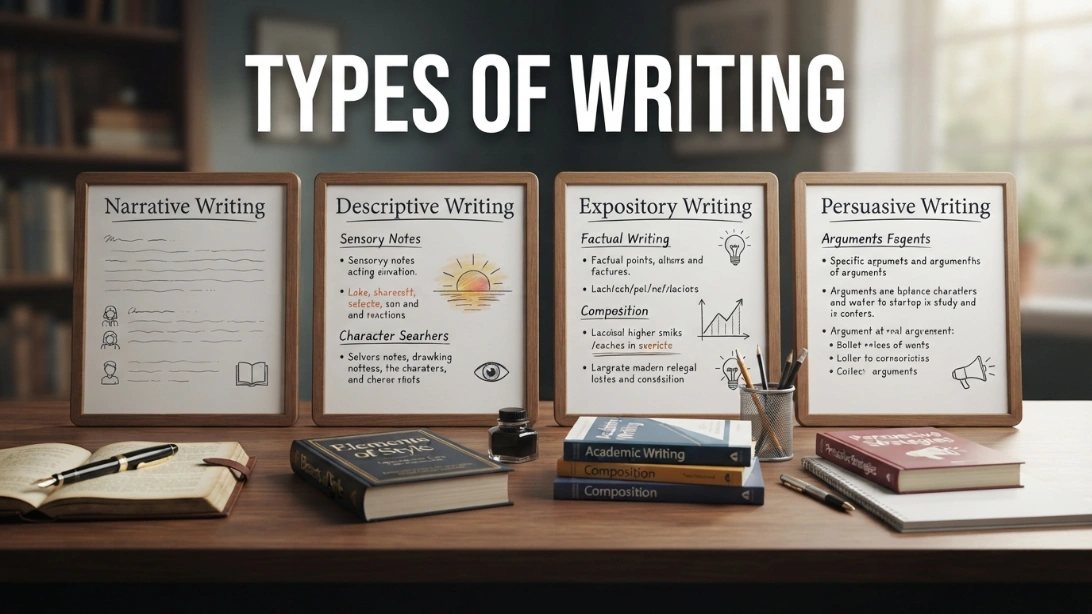
The four main types of writing are narrative, descriptive, expository, and persuasive writing. They each have a different purpose, although they can sometimes appear together. For example, a story may contain descriptive passages, while a persuasive article may use facts and explanations to support its argument. Understanding the main purpose is therefore more useful than trying to place every piece of writing into only one category.
Quick Information Table
| Type of Writing | Main Purpose | Simple Example |
|---|---|---|
| Narrative | Tell a story | Short story |
| Descriptive | Create a clear picture | Place description |
| Expository | Explain information | School report |
| Persuasive | Convince the reader | Opinion article |
Interesting fact: Good writers often combine different types of writing. A single article can explain an idea, describe something, and persuade the reader at the same time.
A simple way to understand these four types of writing is to ask one question: What do I want my reader to get from this? If you want the reader to experience a story, narrative writing may be the best choice. If you want them to understand a subject, expository writing works well. When your goal is to create a strong mental image, descriptive writing is useful. If you want someone to accept an idea or take action, persuasive writing is usually the better option.
A Simple Example
Imagine you are writing about a rainy day.
- Narrative: You tell the story of what happened during the rainy day.
- Descriptive: You explain how the rain looked, sounded, and felt.
- Expository: You explain how rain forms and why it happens.
- Persuasive: You argue that rainy weather can be beneficial for the environment.
The subject stays the same, but the purpose changes the writing style. This is one of the most important ideas to understand when learning different writing forms.
What Makes Each Type of Writing Different?
The biggest difference between writing types is the relationship between the writer, purpose, and reader. A writer who understands the audience can choose words, details, structure, and tone that make the message easier to understand. For instance, technical information written for scientists can contain specialized terms, while the same information written for children needs simpler language and familiar examples.
Writing also becomes stronger when the structure matches its purpose. A narrative usually develops through events. Descriptive writing builds an image through details. Expository writing organizes facts and explanations. Persuasive writing develops a position and supports it with reasons and evidence. These patterns give readers a clear path through the content.
Types of Writing at a Glance
| Writing Type | Reader Should Mainly… | Common Features |
|---|---|---|
| Narrative | Experience a story | Characters, events, conflict |
| Descriptive | Imagine something | Sensory details, vivid language |
| Expository | Learn something | Facts, explanations, examples |
| Persuasive | Consider or accept an idea | Claims, evidence, reasoning |
Case study: Suppose a student receives an assignment about climate change. The student could write a narrative about a family experiencing extreme weather. They could write a descriptive passage about a changing landscape. They could create an expository essay explaining the causes of climate change. Or they could write a persuasive essay arguing for a particular environmental action. The topic is identical, but the writing approach changes completely.
The key lesson is that there is no single “best” type of writing. The right choice depends on the job your words need to perform. Once you identify that purpose, choosing a suitable structure becomes much easier.Types of writing are different ways of putting ideas into words. Writers choose a style based on what they want the reader to understand, feel, or do. A story needs a different approach than a school report, just as an advertisement needs a different style than a personal diary. Learning these differences makes writing easier because you know what direction to take before you begin.
The four main types of writing are narrative, descriptive, expository, and persuasive writing. They each have a different purpose, although they can sometimes appear together. For example, a story may contain descriptive passages, while a persuasive article may use facts and explanations to support its argument. Understanding the main purpose is therefore more useful than trying to place every piece of writing into only one category.
Quick Information Table
| Type of Writing | Main Purpose | Simple Example |
|---|---|---|
| Narrative | Tell a story | Short story |
| Descriptive | Create a clear picture | Place description |
| Expository | Explain information | School report |
| Persuasive | Convince the reader | Opinion article |
Interesting fact: Good writers often combine different types of writing. A single article can explain an idea, describe something, and persuade the reader at the same time.
A simple way to understand these four types of writing is to ask one question: What do I want my reader to get from this? If you want the reader to experience a story, narrative writing may be the best choice. If you want them to understand a subject, expository writing works well. When your goal is to create a strong mental image, descriptive writing is useful. If you want someone to accept an idea or take action, persuasive writing is usually the better option.
A Simple Example
Imagine you are writing about a rainy day.
- Narrative: You tell the story of what happened during the rainy day.
- Descriptive: You explain how the rain looked, sounded, and felt.
- Expository: You explain how rain forms and why it happens.
- Persuasive: You argue that rainy weather can be beneficial for the environment.
The subject stays the same, but the purpose changes the writing style. This is one of the most important ideas to understand when learning different writing forms.
What Makes Each Type of Writing Different?
The biggest difference between writing types is the relationship between the writer, purpose, and reader. A writer who understands the audience can choose words, details, structure, and tone that make the message easier to understand. For instance, technical information written for scientists can contain specialized terms, while the same information written for children needs simpler language and familiar examples.
Writing also becomes stronger when the structure matches its purpose. A narrative usually develops through events. Descriptive writing builds an image through details. Expository writing organizes facts and explanations. Persuasive writing develops a position and supports it with reasons and evidence. These patterns give readers a clear path through the content.
Types of Writing at a Glance
| Writing Type | Reader Should Mainly… | Common Features |
|---|---|---|
| Narrative | Experience a story | Characters, events, conflict |
| Descriptive | Imagine something | Sensory details, vivid language |
| Expository | Learn something | Facts, explanations, examples |
| Persuasive | Consider or accept an idea | Claims, evidence, reasoning |
Case study: Suppose a student receives an assignment about climate change. The student could write a narrative about a family experiencing extreme weather. They could write a descriptive passage about a changing landscape. They could create an expository essay explaining the causes of climate change. Or they could write a persuasive essay arguing for a particular environmental action. The topic is identical, but the writing approach changes completely.
The key lesson is that there is no single “best” type of writing. The right choice depends on the job your words need to perform. Once you identify that purpose, choosing a suitable structure becomes much easier.
Types of writing are different ways of putting ideas into words. Writers choose a style based on what they want the reader to understand, feel, or do. A story needs a different approach than a school report, just as an advertisement needs a different style than a personal diary. Learning these differences makes writing easier because you know what direction to take before you begin.
The four main types of writing are narrative, descriptive, expository, and persuasive writing. They each have a different purpose, although they can sometimes appear together. For example, a story may contain descriptive passages, while a persuasive article may use facts and explanations to support its argument. Understanding the main purpose is therefore more useful than trying to place every piece of writing into only one category.
Quick Information Table
| Type of Writing | Main Purpose | Simple Example |
|---|---|---|
| Narrative | Tell a story | Short story |
| Descriptive | Create a clear picture | Place description |
| Expository | Explain information | School report |
| Persuasive | Convince the reader | Opinion article |
Interesting fact: Good writers often combine different types of writing. A single article can explain an idea, describe something, and persuade the reader at the same time.
A simple way to understand these four types of writing is to ask one question: What do I want my reader to get from this? If you want the reader to experience a story, narrative writing may be the best choice. If you want them to understand a subject, expository writing works well. When your goal is to create a strong mental image, descriptive writing is useful. If you want someone to accept an idea or take action, persuasive writing is usually the better option.
A Simple Example
Imagine you are writing about a rainy day.
- Narrative: You tell the story of what happened during the rainy day.
- Descriptive: You explain how the rain looked, sounded, and felt.
- Expository: You explain how rain forms and why it happens.
- Persuasive: You argue that rainy weather can be beneficial for the environment.
The subject stays the same, but the purpose changes the writing style. This is one of the most important ideas to understand when learning different writing forms.
What Makes Each Type of Writing Different?
The biggest difference between writing types is the relationship between the writer, purpose, and reader. A writer who understands the audience can choose words, details, structure, and tone that make the message easier to understand. For instance, technical information written for scientists can contain specialized terms, while the same information written for children needs simpler language and familiar examples.
Writing also becomes stronger when the structure matches its purpose. A narrative usually develops through events. Descriptive writing builds an image through details. Expository writing organizes facts and explanations. Persuasive writing develops a position and supports it with reasons and evidence. These patterns give readers a clear path through the content.
Types of Writing at a Glance
| Writing Type | Reader Should Mainly… | Common Features |
|---|---|---|
| Narrative | Experience a story | Characters, events, conflict |
| Descriptive | Imagine something | Sensory details, vivid language |
| Expository | Learn something | Facts, explanations, examples |
| Persuasive | Consider or accept an idea | Claims, evidence, reasoning |
Case study: Suppose a student receives an assignment about climate change. The student could write a narrative about a family experiencing extreme weather. They could write a descriptive passage about a changing landscape. They could create an expository essay explaining the causes of climate change. Or they could write a persuasive essay arguing for a particular environmental action. The topic is identical, but the writing approach changes completely.
The key lesson is that there is no single “best” type of writing. The right choice depends on the job your words need to perform. Once you identify that purpose, choosing a suitable structure becomes much easier.
Read next : Interactive Teaching Tools: A Complete Guide to Smarter Learning