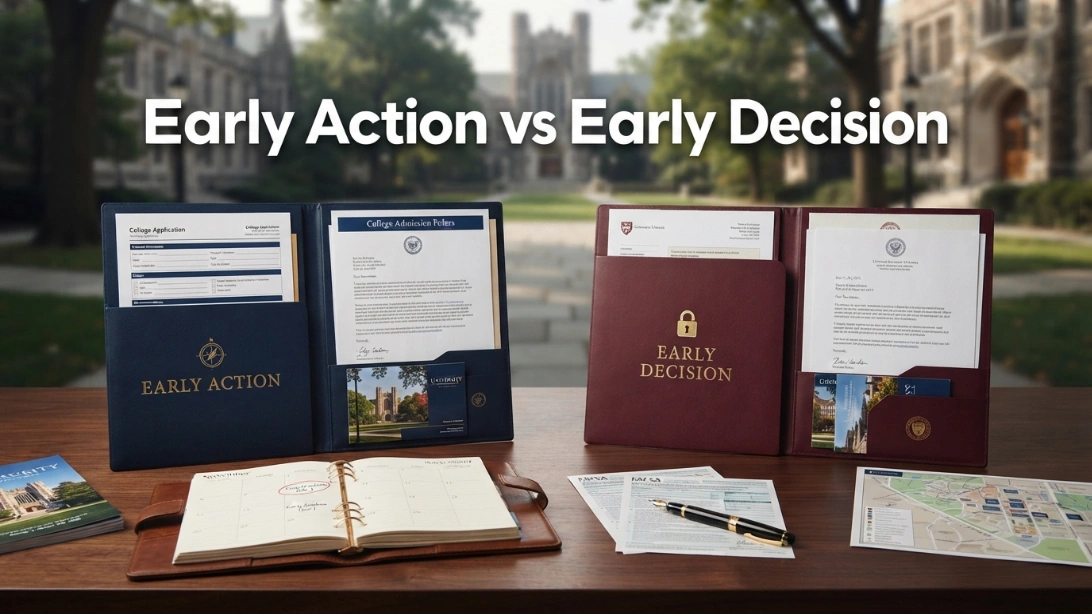
When students begin applying to college, they often hear terms like Early Action (EA) and Early Decision (ED). Both are early college application options, but they are not the same. The biggest difference is commitment. Early Action usually allows students to apply early and receive an earlier admission decision without requiring them to attend. Early Decision is generally a binding commitment, meaning students agree to attend if they are admitted, subject to the institution’s rules and financial aid considerations.
These options can be useful for students who know where they want to apply and are ready to submit their applications before the regular admission deadline. However, applying early is not automatically better. Students should consider their academic record, application readiness, financial situation, and how certain they are about a particular college before choosing between Early Action vs Early Decision.
Important fact: Early Decision is generally binding, while Early Action is generally non-binding.
Early Action vs Early Decision: Key Differences
The clearest way to understand Early Action vs Early Decision is to look at what happens after admission. With Early Action, students normally receive an earlier decision but can continue considering other colleges. With Early Decision, the student has usually made a commitment to enroll if admitted. Because policies differ between colleges, applicants should always read the specific school’s rules before applying.
| Feature | Early Action | Early Decision |
|---|---|---|
| Usually binding? | No | Yes |
| Apply early? | Yes | Yes |
| Earlier admission decision? | Usually | Usually |
| Can compare other offers? | Generally yes | Generally no |
| Best for | Students wanting flexibility | Students with a clear first choice |
| Financial comparison | More flexibility | Less flexibility |
Another important difference involves financial aid. An Early Decision applicant may have fewer opportunities to compare financial aid offers from different colleges because the admission commitment generally comes before comparing multiple final offers. Students who need to compare costs carefully should consider this point before submitting an ED application. Some institutions provide ways to address unaffordable financial aid packages, but applicants should understand the college’s exact policy.
Interesting Fact
Early Action and Early Decision are not simply two different deadlines. They represent different levels of commitment. The application deadline may look similar, but the consequences of acceptance can be very different.
How Early Action Works
With Early Action, a student submits a college application earlier than the regular admission deadline. The college then reviews the application and usually sends an admission decision earlier as well. The student can normally wait before making a final enrollment decision and can continue considering other colleges. This flexibility is one of the biggest reasons students choose EA.
Early Action can be particularly useful for students who have a strong application ready early in their senior year. Receiving an admission decision earlier can reduce some uncertainty and give students more time to consider their choices. However, students should not rush an application simply to meet an early deadline. A stronger application submitted under the appropriate regular deadline can be better than an incomplete or poorly prepared early application.
What Happens After Early Action Admission?
If you are accepted through a typical non-binding Early Action plan, you generally do not have to immediately commit to that college. You can continue reviewing other admission results and financial aid information before making your final choice.
Some colleges also offer Restrictive Early Action or Single-Choice Early Action. These plans can place limits on where else a student may apply early. The rules are different from standard Early Action, so students should carefully read the policy of each institution.
How Early Decision Works
Early Decision is designed for students who have identified a college as their clear first choice. The student applies early and agrees to attend if admitted, according to the college’s ED agreement. This makes ED significantly different from standard Early Action. The student is not simply asking for an earlier answer; they are making a serious commitment.
For that reason, students should think carefully before applying Early Decision. You should be comfortable with the college academically, socially, and financially. It is also important to understand the institution’s financial aid process before signing an Early Decision agreement. Students and families should know how the college handles situations where the financial aid package does not make attendance financially possible.
Early Decision Example
Imagine that Maya has researched several colleges. After visiting campuses, comparing programs, and discussing costs with her family, she decides that College A is clearly her first choice. If College A offers Early Decision and its financial policies work for her family, ED may be worth considering.
Now imagine that Maya is still deciding between four colleges and wants to compare their financial aid packages. Early Decision may not be the best fit, because its binding nature can reduce her flexibility after acceptance.
Good rule: Do not choose Early Decision simply because you believe it will improve your chances. Choose it only when the college is genuinely your first choice and you understand the commitment.
Benefits and Risks of Early Action
One major advantage of Early Action is flexibility. Students can apply early, potentially receive an earlier decision, and still keep their options open. This can make the college process feel less stressful because an applicant may know their status at one school while waiting for other decisions.
EA can also encourage students to finish their applications earlier. This gives them more time later in the school year for other applications, scholarships, exams, and school responsibilities. However, students should remember that early application is not automatically a guarantee of admission.
Main Benefits of Early Action
- Earlier admission information.
- Usually no binding commitment.
- More time to plan after receiving a decision.
- Ability to consider other colleges.
- Potentially less pressure during the regular admission season.
The main risk is rushing the application. Students may feel pressure to submit early even when their essays, grades, activities, or recommendations are not ready. Applying early only makes sense when the application is strong enough to represent the student accurately.
Benefits and Risks of Early Decision
The biggest benefit of Early Decision is that it can demonstrate a very strong interest in a particular college. If a student has a genuine first-choice school and is admitted, the student can move forward knowing where they will attend. The process may also end earlier than regular decision for that applicant.
However, the commitment is also the biggest risk. Students generally cannot treat an ED acceptance like a normal offer that they can casually compare with several others. Because of this, applicants should not use Early Decision as a strategy for a college they are only mildly interested in.
Main Risks of Early Decision
The financial side deserves special attention. College costs can vary significantly, and families may want to compare aid packages. An ED applicant should understand the school’s financial aid approach before applying and should discuss the decision with parents or guardians when appropriate.
Another risk is changing your mind. Students sometimes become more interested in another college later in the application process. With Early Decision, that change of preference can create a serious problem because the plan is based on a commitment.
Early Action vs Early Decision: Which Should You Choose?
There is no universal answer to the question of whether Early Action or Early Decision is better. The right choice depends on your personal circumstances. If you want an early decision but also want to keep your college options open, Early Action may provide the flexibility you need. If you have one clear first-choice college and are comfortable with its commitment requirements, Early Decision may make more sense.
Before choosing, consider your application readiness, academic profile, financial situation, and level of certainty. Do not select ED because someone tells you it is the “best” way to get into college. Likewise, do not choose EA simply because it has an earlier deadline. Your application strategy should fit your goals, not just what other students are doing.
Simple Decision Guide
| Your Situation | Option to Consider |
|---|---|
| You want flexibility | Early Action |
| You have one definite first choice | Early Decision |
| You need to compare financial aid offers | Early Action may offer more flexibility |
| Your application is ready early | EA or ED, depending on your goals |
| You are unsure about your top college | Avoid rushing into ED |
Case study: Daniel has excellent grades and a strong application but is choosing between three universities. He wants to compare academic programs and financial aid. Early Action could give him an earlier decision while preserving his ability to compare choices.
Sarah, on the other hand, has carefully researched one university and knows it is her first choice. Her family has also reviewed the school’s financial information and understands the ED commitment. In that situation, Early Decision could be a reasonable option.
The most important thing is to read the specific college’s policy. Early plans vary by institution, especially when it comes to application restrictions, deadlines, deferrals, and financial aid. Never assume that every college uses exactly the same rules.
Frequently Asked Questions About Early Action vs Early Decision
Is Early Action better than Early Decision?
Neither is automatically better. Early Action generally provides more flexibility because it is usually non-binding. Early Decision can make sense for students who have one clear first-choice college and are comfortable with the commitment. The best option depends on your application readiness, financial situation, and personal goals.
Is Early Decision legally binding?
Early Decision is generally considered a binding college admission agreement, subject to the institution’s policies and applicable circumstances. Students should understand the specific ED agreement before applying. If financial aid is a major concern, review the school’s financial aid policies carefully before making the commitment.
Can I apply Early Action and Early Decision?
It depends on the colleges and the type of Early Action plan involved. Standard Early Action may allow applications to multiple schools, while Restrictive Early Action or Single-Choice Early Action can have additional restrictions. Always check each college’s current application rules.
Does Early Decision increase admission chances?
Early Decision can sometimes have different admission patterns than Regular Decision, but students should not assume that applying ED guarantees or automatically improves admission chances. Colleges evaluate applicants individually. A strong academic record and well-prepared application remain important.
Which is better if I need financial aid?
Students who need to compare financial aid offers may prefer a non-binding option such as standard Early Action because it generally leaves more room to compare colleges and costs. However, financial aid policies vary. Review each college’s current policies and discuss affordability with your family before choosing an application plan.