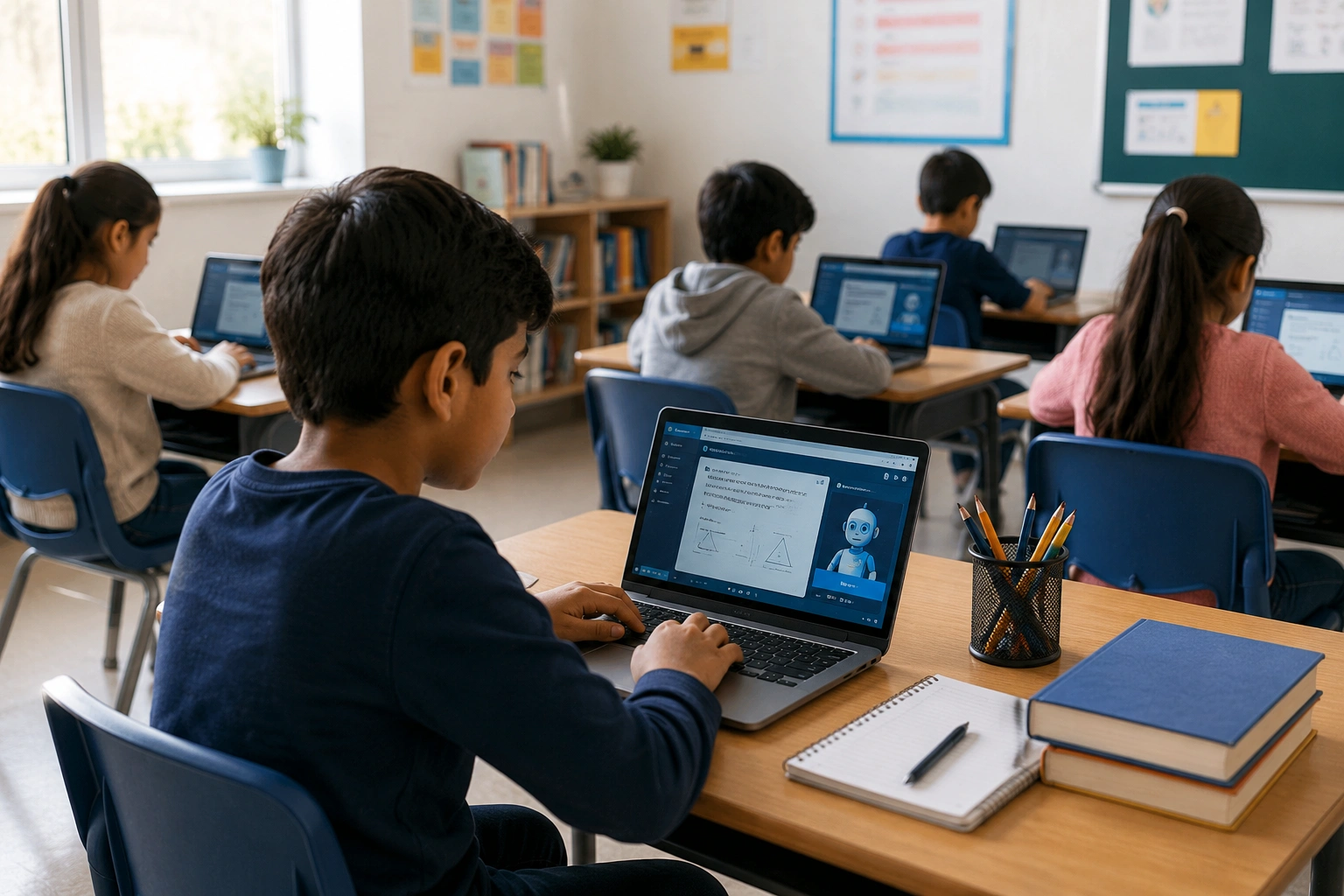
AI-powered tutors are digital learning assistants that use artificial intelligence to help students understand subjects, practice skills, and work through difficult questions. Unlike a traditional textbook, an AI tutor can respond to a student’s specific question and change its explanation when the first answer is not clear. For example, a student struggling with fractions can ask for a simpler explanation, a real-life example, or another practice question. This makes AI-powered tutors for education feel more like an interactive study partner than a static learning resource.
The biggest difference between a useful AI tutor and a basic chatbot is how it teaches. A well-designed educational AI should not always rush to give the final answer. Instead, it can break a difficult topic into smaller steps, ask guiding questions, point out mistakes, and encourage the learner to solve part of the problem independently. This approach can be especially useful for students who need extra practice but may not have access to one-on-one tutoring whenever they need it. AI tutors can support learning at home, during revision, or between classroom lessons, while teachers and parents still provide the human guidance that technology cannot replace.
How Does an AI Tutor Work?
An AI tutor generally uses language models and other educational technologies to understand what a learner is asking and generate a response based on the context. A student might type a question such as, “Why does photosynthesis need sunlight?” The tutor can answer at a basic level, provide a more detailed scientific explanation, create a short quiz, or ask follow-up questions to see whether the student actually understands the idea.
The more useful systems also try to adapt the learning experience. They may adjust the difficulty of questions, provide hints after an incorrect response, or explain the same concept in a different way. This personalization is one of the main reasons AI tutoring has become important in modern education. Instead of forcing every student through exactly the same explanation, an AI tutor can respond to different learning needs and speeds.
What Makes an AI Tutor Different From a Regular AI Chatbot?
A regular AI chatbot can answer educational questions, but answering a question is not necessarily the same as teaching. A student could ask a chatbot to solve a mathematics problem and receive the correct result within seconds. That may be convenient, but if the student does not understand how the answer was reached, the interaction has limited educational value.
A stronger AI tutor for students focuses on the learning process. It may ask what the student already knows, identify the step where they became confused, and offer a hint rather than immediately revealing the solution. In other words, the goal is not simply “Here is your answer,” but “Let us understand how you can reach the answer yourself.” That difference matters because real learning depends on understanding, practice, feedback, and the ability to apply knowledge to a new problem.
Who Can Use AI-Powered Tutors?
AI tutors can be useful for many types of learners, although the right tool depends heavily on age, subject, and learning goals. A younger student may need a simple interface and strong parental or teacher supervision, while a university student might need help with advanced mathematics, research concepts, coding, or exam preparation. Adult learners can also use AI tutors to refresh old knowledge or learn a completely new skill.
Common users include:
| Learner | Common Uses |
|---|---|
| School students | Homework support, explanations, quizzes, and revision |
| High school students | Exam preparation, mathematics, science, and writing |
| College students | Complex subjects, study planning, and concept review |
| Adult learners | Skill development and learning new subjects |
| Teachers | Creating practice activities and supporting different learning levels |
| Parents | Providing additional supervised learning support at home |
The important point is that an AI tutor should be treated as a learning tool, not an automatic replacement for a teacher. Teachers understand classroom behavior, emotional needs, student motivation, and individual circumstances in ways an AI system cannot fully reproduce. The most useful approach is often to combine AI-based practice with human instruction, discussion, feedback, and real-world learning.
Best AI-Powered Tutors for Education in 2026
The market for AI-powered tutors for education has grown quickly, but the best tool depends on what a student actually needs. Some platforms are designed to teach through guided questions, while others are stronger for mathematics, flashcards, personal study materials, or general academic support. Recent 2026 comparisons commonly highlight tools such as Khanmigo, ChatGPT Study Mode, NotebookLM, Quizlet, Photomath, and customized AI tutoring platforms, but there is no single option that is perfect for every learner.

A useful way to judge an AI tutor is to ask one simple question: Does it help the student learn, or does it simply help the student finish the task? Research is increasingly making this distinction important. A systematic review of 88 empirical studies found benefits from large language models in areas such as academic performance and engagement, while also identifying concerns including over-reliance, privacy, fairness, and technical reliability.
Khanmigo — Best for Guided AI Tutoring
Khanmigo is built around an education-first approach and is particularly interesting for students who need guidance rather than instant answers. Instead of treating every question like a simple search request, it can encourage learners to think through a problem and work toward the answer. This makes it a strong choice for students who want something closer to a digital tutoring conversation.
Its biggest advantage is the teaching approach. A student can make a mistake and continue the conversation rather than simply receiving a final result. For learning, that difference can be more important than speed. It is especially useful when the goal is to understand a concept instead of completing one assignment as quickly as possible.
ChatGPT Study Mode — Best for General Learning
ChatGPT can serve as a broad AI study tutor because students can use it across many subjects and ask for explanations at different difficulty levels. A student studying biology might request a simple explanation first and then ask for a university-level explanation. The same flexibility can be useful for mathematics, history, writing, science, coding, and exam preparation.
The important part is how the student uses it. A good tutoring prompt might ask the AI to ask questions, provide hints, identify mistakes, and wait for the student’s attempt before giving the answer. Current 2026 study-tool comparisons frequently place ChatGPT Study Mode among the strongest general-purpose options because of this interactive learning style.
Google NotebookLM — Best for Studying Personal Materials
NotebookLM is particularly useful when students want to learn from their own materials. Instead of starting with a completely open-ended question, a learner can work with documents such as class notes, readings, or other study resources. This makes it useful for students preparing for an exam from a specific syllabus or collection of materials.
Its source-focused approach can also make studying more organized. Students can use their materials to build study guides, review important concepts, and generate practice content. It should still be checked carefully, but grounding an AI interaction in the learner’s own course materials can reduce the problem of receiving an answer that is unrelated to what the student is actually expected to learn.
Quizlet — Best for Revision and Active Recall
Quizlet is a strong option for students whose biggest challenge is remembering information. Flashcards, practice questions, and repeated recall can be useful for vocabulary, definitions, formulas, historical dates, scientific terms, and other information-heavy subjects.
The real value is not simply creating digital flashcards. Active recall requires the learner to retrieve information from memory, which is different from repeatedly reading the same notes. AI features can make it easier to turn existing study material into practice activities, but students should still attempt questions themselves rather than passively reading AI-generated explanations.
Photomath — Best AI Tutor for Mathematics
Photomath is especially useful when mathematics is the problem. Students can use a camera to capture a mathematical expression and receive an explanation of the steps involved. This can be helpful when a learner knows the general topic but cannot identify where a calculation went wrong.
However, mathematics students should be careful about using any problem-solving application as an answer machine. If a student scans every homework problem and copies the result, the technology may improve the homework score without improving mathematical ability. The better approach is to attempt the problem first, use the explanation to identify the mistake, and then solve a similar problem without assistance.
Jotform AI Tutor — Best for Customized Learning
Jotform AI Tutor takes a different approach by allowing educators and organizations to create tutoring experiences around specific educational content. This can be useful when a generic chatbot does not know enough about a particular course, training program, or collection of materials.
Customization can be particularly valuable for teachers because the tutor can be designed around the information learners are actually expected to study. Current AI tutor comparisons include customized tutoring among the important developments in the education space, showing that the market is moving beyond simple question-and-answer chatbots toward more structured learning experiences.
Quick Comparison of the Best AI Tutors
| AI Tutor | Best For | Main Strength |
|---|---|---|
| Khanmigo | Guided school learning | Socratic-style tutoring |
| ChatGPT Study Mode | General studying | Flexible explanations and practice |
| NotebookLM | Personal study materials | Learning from supplied sources |
| Quizlet | Revision | Flashcards and active recall |
| Photomath | Mathematics | Step-by-step math support |
| Jotform AI Tutor | Custom learning | Tutor experiences based on specific materials |
What Features Should the Best AI-Powered Tutors Have?
The best AI-powered tutors for education should do more than generate grammatically correct answers. They should understand the learner’s question, provide an explanation that matches the learner’s level, respond to mistakes, and encourage active participation. A student who is struggling with algebra, for example, may need a visual explanation and a simple example rather than a complicated mathematical definition.
Good AI tutoring also requires a balance between convenience and productive effort. If an AI system performs every difficult part of the task, students may become dependent on it. The OECD’s 2026 Digital Education Outlook makes a similar distinction: generative AI can support learning when it is guided by sound teaching principles, but completing tasks with AI does not automatically mean that genuine learning has occurred.
Personalized Learning
Personalization is one of the most attractive features of AI tutoring. A traditional lesson usually has to work for many students at once, while an AI tutor can respond to an individual learner’s question and adjust the explanation.
For example, one student may understand fractions but struggle with decimals, while another may have the opposite problem. A flexible AI tutor can provide different explanations and different levels of practice instead of forcing both learners through exactly the same material.
Step-by-Step Teaching
A useful tutor should show students how to think through a problem. This is especially important in mathematics, science, coding, and writing, where knowing the process is often more valuable than knowing one final answer.
Students can ask the tutor to break a difficult problem into smaller stages. They can also request hints rather than solutions. This approach encourages independent thinking and reduces the temptation to copy.
Interactive Quizzes and Practice
Practice is where AI tutoring can become more useful than a simple explanation. After explaining a topic, an AI tutor can generate questions that test whether the learner actually understands it.
A strong study session might follow this pattern:
- Learn the concept.
- Answer a practice question.
- Review the mistake.
- Try a slightly harder question.
- Explain the concept without help.
This creates a learning cycle rather than a one-time conversation.
Support for Multiple Subjects
General-purpose AI tutors can cover many subjects, including mathematics, science, languages, history, writing, programming, and general knowledge. However, broad coverage does not always mean equal quality in every subject.
Students should check important answers against reliable educational sources, especially when dealing with advanced science, medical topics, historical details, or technical information. AI can sound confident even when an answer needs correction, so confidence should never be confused with accuracy.
Voice, Images, and Documents
Modern AI learning tools increasingly support more than typed questions. Depending on the platform, students may be able to work with images, documents, voice conversations, or other educational materials.
These features can make tutoring more natural. A student could photograph a difficult equation, upload lecture notes, or explain a problem verbally. For learners who find typing difficult or who learn better through different formats, multimodal interaction can make AI tutoring more accessible.
Progress Tracking and Teacher Controls
For schools, progress tracking and teacher controls can be just as important as the AI’s ability to answer questions. Teachers may need to know whether students are improving, where they are struggling, and whether AI is being used as a learning aid or simply as a shortcut.
This is one reason an AI tutor designed for an individual student is not necessarily the right solution for a school. Educational institutions also have to consider privacy, curriculum alignment, access, teacher oversight, and responsible-use policies.
Benefits of AI Tutors in Education
One of the strongest benefits of AI tutoring is access to personalized support when a student needs it. A learner does not have to wait until the next class to ask why a formula works or why an essay argument is weak. The AI can provide an explanation, create another example, and continue the discussion. This can be especially useful for students who need more practice than classroom time allows.
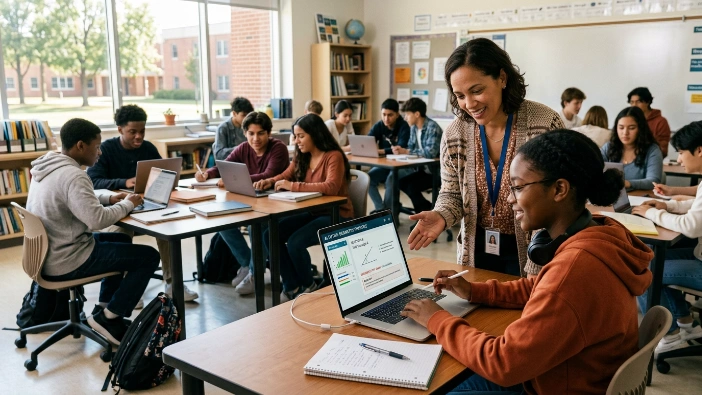
Research supports some of these potential benefits, although the evidence is still developing. A systematic review of AI-driven intelligent tutoring systems examined 28 studies involving 4,597 K–12 students and found generally positive effects on learning and performance, while noting that more long-term and diverse research is needed.
Personalized One-on-One Learning
One-to-one tutoring has traditionally been difficult to provide at scale because it requires time, money, and trained tutors. AI can offer a different model by allowing many learners to receive individualized explanations at the same time.
This does not mean AI provides the same quality as an experienced human tutor in every situation. Instead, its value comes from providing additional practice and immediate assistance when a human tutor or teacher is not available.
24/7 Access to Learning Support
Students do not only have questions during school hours. Homework, revision, and exam preparation often happen in the evening or on weekends.
An AI tutor can be available whenever the learner wants to practice. This can make education more flexible, particularly for students balancing school with work, family responsibilities, or other commitments.
Faster Feedback
Traditional assignments can take time to receive feedback. AI can respond almost immediately, allowing students to identify mistakes while the topic is still fresh in their minds.
Fast feedback is most useful when it explains why something is wrong. Simply saying “incorrect” does not teach much. A better tutor points toward the misunderstanding and gives the learner another opportunity to correct it.
Greater Student Confidence
Some students hesitate to ask questions in front of a classroom. They may worry that their classmates will judge them or that they should already know the answer.
A private AI conversation can reduce that barrier. Students can ask basic questions repeatedly, request simpler explanations, and practice before discussing the subject with a teacher or classmates.
Support for Teachers and Parents
AI tutors can also support adults rather than focusing only on students. Teachers can use AI to create practice questions, adapt explanations, or develop additional learning materials.
Parents may use AI tools to understand what their child is studying and provide extra practice. However, adult supervision remains important for younger children because AI-generated content can contain errors or be inappropriate for a particular age or curriculum.
Interesting Fact About AI Tutoring
Interesting fact: A large 2026 systematic review examined 88 empirical studies on large language models in education and found that intelligent tutoring systems were the most common educational application among the categories reviewed. The same review also identified concerns about over-reliance, privacy, fairness, and technical reliability.
Are AI-Powered Tutors Safe and Effective for Students?
AI tutors can be highly useful, but calling every AI tutor automatically safe or effective would be misleading. The quality of the learning experience depends on the tool, the subject, the student’s age, the way the system is designed, and how the student uses it. Evidence from K–12 research is promising but still limited, and education researchers continue to study the long-term effects of AI-supported learning.

The biggest concern is outsourcing thinking. If students use AI to perform every difficult part of their work, they may become better at completing AI-assisted tasks without becoming better at the underlying subject. A large high-school mathematics field experiment found that AI tutoring improved performance while students had access to AI, but students could perform worse when the technology was removed; carefully designed hints rather than answer-giving helped reduce this problem.
Can AI Tutors Give Wrong Answers?
Yes. AI systems can make factual, mathematical, logical, or contextual mistakes. Sometimes the mistake is obvious, but other times the response may sound extremely convincing.
Students should be especially careful when an answer affects grades, exams, research, or important decisions. Asking the AI to explain its reasoning can help, but verification from a trusted source is still necessary.
Can AI Tutors Encourage Cheating?
They can if they are used as answer generators. A student can ask an AI to write an essay, solve an entire worksheet, or complete a programming assignment without understanding any of it.
Responsible use looks different. Students can ask for explanations, hints, examples, practice questions, feedback on their own attempts, and quizzes. The objective should be to use AI to make learning stronger rather than to avoid learning.
What About Student Privacy?
Privacy becomes particularly important when children use AI systems. Students may upload names, school documents, assignments, photographs, conversations, or other personal information without realizing how sensitive that material can be.
Parents, teachers, and schools should review a tool’s privacy practices before allowing regular use. They should also teach students a simple rule: do not share sensitive personal information with an AI system unless there is a clear and approved reason to do so.
Can AI Tutors Replace Human Teachers?
AI tutors can support teachers, but they should not be treated as complete replacements for them. A teacher does much more than explain information. Teachers understand classroom relationships, motivation, student behavior, social development, and the circumstances that affect learning.
The strongest educational model is therefore not AI versus teachers. It is AI plus teachers. The OECD reports that generative AI can augment teaching and tutoring while preserving teacher agency, and current education guidance similarly emphasizes using AI to support rather than replace student thinking and human relationships.
How to Choose the Best AI-Powered Tutor for Education
Choosing the best AI tutor starts with the learner rather than the brand name. A primary-school student, university student, language learner, and mathematics student may all need completely different features. Before selecting a platform, decide whether the main goal is homework help, concept learning, exam preparation, revision, personalized tutoring, or learning from specific course materials.
It is also important to test how the tool behaves when the student gives a wrong answer. The best AI-powered tutor for education should help the learner recover from mistakes instead of simply replacing the learner’s effort. Look for clear explanations, useful questions, appropriate difficulty, reliable information, privacy protections, and features that encourage independent thinking.
Choose Based on Student Age
Younger learners generally need stronger supervision and simpler explanations. Parents and schools should pay particular attention to age suitability, privacy, content controls, and whether adults can monitor or guide the learning experience.
Older students may need more advanced features, such as support for research, programming, complex mathematics, or university-level subjects. The right AI tutor should match both the student’s academic level and their ability to evaluate AI-generated information.
Choose Based on Subject
Different AI tutors have different strengths. A mathematics-focused application may be more useful for equations than a general chatbot, while a source-based study tool may be better for reviewing a history course.
Before choosing, identify the student’s main subject and compare tools based on teaching quality rather than the number of features.
Check the Teaching Style
Ask whether the AI:
- Explains concepts clearly.
- Provides hints instead of immediately giving answers.
- Adjusts explanations to the student’s level.
- Creates useful practice questions.
- Corrects misunderstandings.
- Encourages the student to attempt problems independently.
These features are more meaningful for education than simply having a sophisticated chatbot interface.
Compare Free and Paid AI Tutors
Free AI tutors can be enough for basic explanations, practice, and revision. Paid versions may provide additional limits, advanced features, deeper customization, or specialized learning experiences.
Price should not be the first deciding factor. A free tool that encourages independent learning may be more valuable than a paid system that simply completes assignments.
Consider Privacy, Safety, and Teacher Controls
For children and school environments, privacy and safety deserve the same attention as educational quality. Schools should also consider whether the platform fits their curriculum and whether teachers can understand how students are using it.
This is becoming increasingly important as schools develop formal AI policies. Recent reporting shows that schools are moving toward AI literacy that includes understanding misinformation, privacy risks, bias, and knowing when AI should not be used.
Test the Tutor Before Committing
A simple test can reveal a lot. Give several AI tutors the same question and compare their explanations.
Then make the test more difficult. Give an incorrect answer and see whether the tutor identifies the mistake. Ask for a simpler explanation, a real-world example, and a practice question. A genuine tutor should adapt to the learner rather than repeatedly produce the same type of answer.
Frequently Asked Questions About AI-Powered Tutors
What is the best AI-powered tutor for education?
There is no single AI tutor that is best for every student because learning needs are different. Khanmigo is a strong choice for guided, education-focused tutoring, while ChatGPT Study Mode is useful for broad subjects and flexible explanations. NotebookLM can be particularly useful when students want to study from their own documents, and Photomath is designed around mathematics. Quizlet is useful for revision and active recall. The best option depends on the learner’s age, subject, budget, and preferred study method. Most importantly, students should choose a tutor that encourages understanding instead of simply providing completed answers.
What is the best AI tutor for students?
The best AI tutor for students is usually the one that matches their specific learning goal. A student who needs help understanding algebra may benefit from a math-focused tool, while someone preparing for several subjects may prefer a general AI tutor. Students studying from lecture notes may find a source-based tool more useful. When comparing options, look at teaching style, accuracy, personalization, practice features, privacy, and ease of use. It is also worth testing several tools before choosing one. A good AI tutor should make students more independent over time rather than making them dependent on AI for every question.
Are AI tutors better than human tutors?
AI tutors are not automatically better than human tutors. They have advantages such as constant availability, fast responses, unlimited patience, and the ability to generate customized practice. Human tutors provide something different: emotional understanding, motivation, judgment, personal experience, and the ability to respond to complex situations outside a computer’s understanding. Research suggests AI can support learning, but current evidence also warns that poorly guided use can reduce students’ cognitive effort. The strongest approach is often to combine both. AI can provide extra explanations and practice, while teachers and tutors provide human guidance, encouragement, correction, and deeper educational support.
Can AI tutors help with homework?
Yes, AI tutors can help with homework when students use them as learning assistants. They can explain difficult concepts, provide hints, check a student’s attempt, create similar practice problems, and help identify mistakes. The problem begins when students ask AI to complete the entire assignment and submit the output as their own work. That approach may save time but can weaken learning. A better method is to attempt the homework first and then use AI to understand where the difficulty occurred. Research in mathematics has found that unrestricted AI assistance can improve performance during AI-supported practice without necessarily improving independent performance later.
Are AI-powered tutors safe for children?
AI-powered tutors can be useful for children, but they require appropriate safeguards and adult supervision. Parents and schools should consider the child’s age, the platform’s privacy practices, content controls, accuracy, and whether the system is designed specifically for young learners. Children should also be taught not to share sensitive personal information with AI tools. Another important safety issue is educational dependence. Children should continue solving problems, reading independently, communicating with teachers, and developing their own reasoning skills. AI should act as an additional learning resource rather than becoming the child’s only source of explanations or answers. Current education guidance recommends careful evaluation of AI tools for learning, privacy, access, and student development.
Final Verdict: Which AI-Powered Tutor Is Right for You?
The best AI-powered tutors for education are not necessarily the tools with the biggest feature lists or the most impressive AI models. The better choice is the tutor that understands the learner’s needs, explains difficult ideas clearly, provides useful practice, and encourages the student to think independently. Khanmigo, ChatGPT Study Mode, NotebookLM, Quizlet, Photomath, and customized AI tutors can each serve different purposes, so comparing them by learning goal is more useful than choosing one universal winner.
AI tutoring is becoming an important part of modern education, but the technology works best when it supports human teaching rather than trying to replace it. The strongest learning experience combines AI assistance, active student participation, reliable information, teacher or parent guidance, and regular practice without AI. Used this way, the best AI-powered tutors for education can become valuable study partners while still keeping the most important part of education where it belongs: with the learner.
Quick Facts to Remember
| Fact | Why It Matters |
| AI tutors can personalize explanations | Students can learn at different speeds |
| AI can make mistakes | Important information should be verified |
| Answer generation is not the same as learning | Students still need to think and practice |
| AI works best with guidance | Teachers and parents remain important |
| Privacy matters | Students should avoid sharing sensitive information |
| Different tutors have different strengths | The best choice depends on the learner |
“The goal should not be to make learning effortless. The goal should be to make learning more effective.”
The future of education is unlikely to be about choosing between people and artificial intelligence. It is more likely to be about learning how to use both wisely. When AI gives students another explanation, another practice opportunity, or a helpful hint at exactly the right moment, it can add real value. But when it does the thinking that students need to do themselves, convenience can come at the cost of learning.