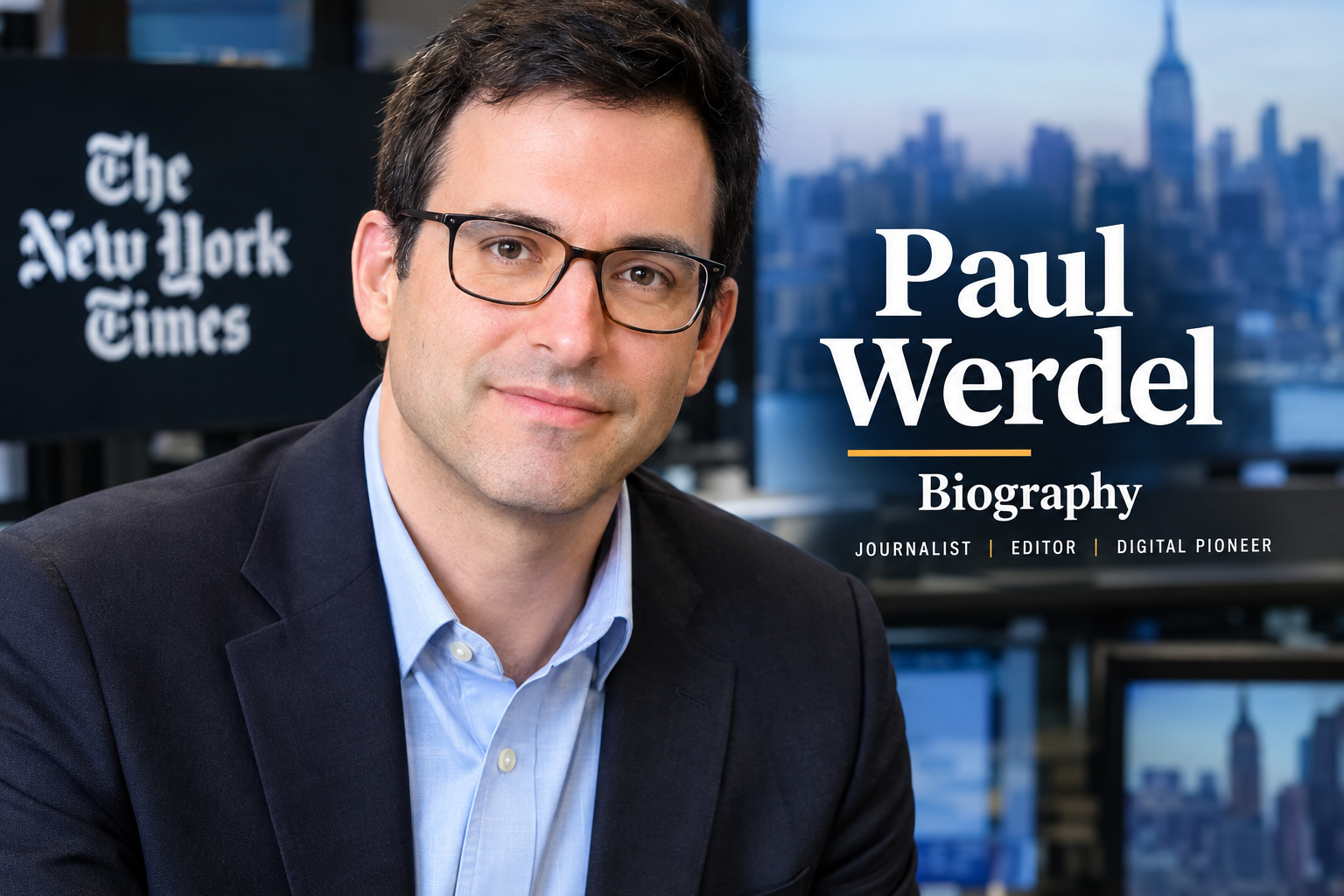
His professional path moved through broadcast news, international journalism, digital publishing, and product strategy. His résumé includes BBC World News, Al Jazeera English, Talking Points Memo, and The New York Times. [Insert Professional Profile Reference Link Here]
That career makes Paul Werdel biography searches more interesting than they first appear.
He is also known publicly through his marriage to journalist Amna Nawaz. The couple married in 2007. They have two daughters. [Insert Major Profile Reference Link Here]
Yet marriage is only one part of Werdel’s story.
His professional life followed the transformation of journalism itself. He began in television production. He later moved toward digital platforms and mobile news products.
At The New York Times, that shift became especially clear.
His career shows how journalism changed as audiences moved from television and newspapers toward digital screens.
Paul Werdel at a Glance
| Detail | Information |
|---|---|
| Full Name | Paul Werdel |
| Date of Birth | Not publicly confirmed |
| Place of Birth | Not reliably confirmed |
| Nationality | American |
| Key Profession | Journalist, editor, digital product professional |
| Major Achievements | BBC World News, Al Jazeera English, TPM, The New York Times |
The Foundations: Journalism Before Recognition
Reliable details about Werdel’s childhood remain limited.
Unlike many public figures, he has not built a public identity around his upbringing. Claims about his parents, siblings, childhood experiences, and exact birthplace appear across biography websites, but strong primary documentation is limited.
That makes caution necessary.
His education and professional record offer a clearer picture.
Public career profiles connect Werdel with the University of Maryland. He studied journalism and completed his undergraduate education there in 2002. [Insert University/Professional Profile Reference Link Here]
His university years also included hands-on television work.
Werdel worked with UMTV, the university’s television operation. His reported position as News Studio Manager ran from 2000 to 2002. [Insert Professional Profile Reference Link Here]
That experience mattered.
Television news demands timing. It demands coordination. It also punishes mistakes.
A newsroom must move quickly. Producers must make decisions under pressure. Technical teams must keep broadcasts moving.
Werdel gained that experience early.
After graduation, he remained connected to the University of Maryland. Professional records list him in broadcast journalism and production roles during 2003 and early 2004. [Insert Professional Profile Reference Link Here]
This period formed a practical bridge.
He had studied journalism.
Now he was learning how journalism worked inside a real production environment.
That distinction later became important.
Werdel did not remain limited to traditional reporting. His career gradually expanded toward editorial management, digital publishing, and technology.
The change reflected the industry around him.
Newsrooms were entering a major digital transition. Websites were becoming essential. Mobile audiences were growing. Editors increasingly needed to understand technology.
Werdel’s career eventually placed him directly inside that transformation.
From BBC Broadcasts to International Newsrooms
Werdel reached a major career milestone in 2004.
He joined BBC World News as a producer and director. Public career records place his BBC tenure from June 2004 to June 2007. [Insert BBC/Professional Reference Link Here]
The role required more than basic production.
He worked on BBC World News broadcasts aimed at American audiences. His responsibilities reportedly included scripts, news packages, running orders, guests, and live production tasks. [Insert Major News Reference Link Here]
The Washington Post also identified Werdel in 2007 as a producer working alongside anchor Katty Kay. The article described him handling tasks ranging from scanning news wires to booking guests and feeding taped material to London.
That detail gives useful context.
He was not simply sitting behind a desk.
He was part of the machinery that turned breaking information into television news.
In 2007, another major move followed.
Werdel joined Al Jazeera English in Washington, D.C. Professional references identify him first as Deputy News Editor and later as News Editor.
A 2010 Washington Report on Middle East Affairs article also identified him as a News Editor at Al Jazeera English.
This was a significant expansion of his editorial experience.
Al Jazeera English operated with a global audience. Its newsroom brought together journalists from many countries and professional backgrounds.
Werdel therefore moved deeper into editorial decision-making.
He was no longer focused only on producing individual broadcasts.
He was helping shape news coverage.
His next move pushed him further into digital journalism.
The Digital Turn: TPM and The New York Times
Around 2011, Werdel joined Talking Points Memo, commonly known as TPM.
TPM was already part of the growing digital-news ecosystem. Its publishing model differed from traditional television broadcasting.
The change suited Werdel’s developing skill set.
A TPM archive identified him as an Associate Editor. Later professional records describe him as a Senior Associate Editor. [Insert TPM Reference Link Here]
TPM’s own anniversary material later described Werdel as an editor and product director at The New York Times from 2012 to 2018.
The next chapter became the defining professional stage of his career.
Werdel joined The New York Times in 2012.
His positions included Assistant Editor for Digital Platforms, Senior Editor of Platforms, Senior Product Manager for Mobile, and Product Director. Public professional records document this progression.
The titles reveal a broader change.
Werdel was moving from journalism production toward journalism technology.
That meant thinking about how readers received news.
Mobile phones had become central to news consumption. Homepages mattered. Apps mattered. Digital interfaces mattered.
Editorial judgment alone was no longer enough.
News organizations also needed people who understood products.
Werdel occupied that intersection.
His New York Times work also included writing. Muck Rack lists verified New York Times articles under his name from the 2014 FIFA World Cup, including reports on Algeria versus Russia and the Netherlands versus Chile.
Those bylines show that his journalism skills remained active.
But his larger contribution came through digital products.
He understood the newsroom.
He also understood the technology carrying its journalism to readers.
That combination became increasingly valuable.
The 2018 Decision That Changed His Story
In 2018, Werdel left The New York Times.
The decision coincided with a major change in his family life.
Amna Nawaz joined PBS NewsHour in 2018. A profile in The Pennsylvania Gazette later described Werdel as a former New York Times product director who had become the primary caregiver for the couple’s two daughters.
This became one of the most discussed parts of his public story.
Werdel had reached a senior position at a globally recognized newspaper.
Then he stepped away.
The move challenged the usual media-career narrative.
Instead of measuring success only through professional advancement, the decision reflected a family priority.
Nawaz’s career was entering a demanding phase. PBS NewsHour involved reporting, anchoring, travel, and major national stories.
Werdel took on more responsibility at home.
That choice also explains why his public profile became quieter.
He had spent years inside newsrooms.
Now much of his work happened outside them.
Marriage, Family, and Life Away From the Spotlight
Werdel and Amna Nawaz married in 2007.
Their relationship is unusual in one simple way.
Both partners built careers in journalism.
Nawaz became the more visible public figure. She has worked for NBC News, ABC News, and PBS NewsHour. [Insert PBS Reference Link Here]
Werdel followed a less visible route.
Their family life has largely remained private.
The couple has two daughters. Public profiles have repeatedly noted their preference for protecting their children from unnecessary exposure. [Insert Major Profile Reference Link Here]
That privacy is consistent with Werdel’s broader public identity.
He rarely appears in the spotlight.
His professional reputation comes mainly from career records and colleagues’ references.
His story therefore cannot be measured through celebrity appearances.
It is measured through newsroom work.
Where Paul Werdel Stands Today
Werdel’s exact current professional status should be treated carefully because his public career information is less extensive than that of his wife.
Some recent online profiles report that he returned to professional work in product strategy after his period as a primary caregiver. Other sources associate him with digital product work outside his former New York Times position. [Insert Current Professional Profile Reference Link Here]
What remains clear is the shape of his career.
He began with broadcast production.
He moved into international news.
He entered digital journalism.
He then moved into product leadership.
That progression mirrors the broader transformation of the news industry.
His experience connects two worlds.
One is traditional journalism.
The other is digital technology.
That combination remains relevant as newsrooms continue adapting to changing audience habits.
What Paul Werdel’s Journey Teaches
- Build adaptable skills: Journalism changed, and Werdel changed with it.
- Learn the machinery: Strong media work involves technology and editorial judgment.
- Accept career shifts: A professional path rarely moves in one straight line.
- Value family choices: Career achievement does not define every important decision.
Disclaimer: This biography is compiled from publicly available professional records, interviews, established news coverage, and other accessible sources. Where personal details could not be independently verified, they have been identified as unconfirmed. This article is intended solely for educational and informational purposes.
Read more:TechTrendery.com: Website, Content, Purpose, and Current Profile